

RBA and Fed tightening both remain under-priced. Bond market sending a tightening cycle. Australian underemployment and Fed Minutes the focus this week.
Key points
- US longer-yields ended the week broadly unchanged in spite of favourable CPI and Retail Sales data. This kept Australian longer-yields elevated despite the RBA leaving interest rates unchanged at its August Board Meeting.
- Japanese longer-dated yields and slightly higher oil prices were a factor in US yield developments, but the continuing rise in yields can also be interpreted as a market signal that US monetary policy needs to tighten somewhat, albeit not dramatically.
- This week’s FOMC Minutes may provide some indication of any further shift in the direction of some firming of US policy. Manufacturing indicators have been strengthening on account of stronger AI-related spending, which is an important component of my view that AI spending is producing some demand-driven inflationary pressures, which the Fed will eventually respond to.
- In Australia, the RBA’s latest Board meeting still appeared much more hawkish to me than the market interpreted. The Board considered a rate increase at the August meeting –something it did not in June – and warned of upside risks to inflation. Typically, the RBA has often moved within three months of identifying upside (or downside) risks. The Governor also suggested in her press conference that she personally thought the Bank would likely have to tighten further, with the Board still wanting to continue assessing how the economy and inflation were responding to the previous three interest rate rises.
- This week sees the release of Australian labour market and wages data. Q3 wages data is likely more important than this week’s Q2 data, given higher minimum wage increases from 1 July. Any increase above the 0.8% q/q rise forecast for Q2 would not be helpful.
- The risk on employment is likely on the downside given last month’s very robust print, but that may not be significant given that prior strength and recent monthly volatility. The Australian Census could boost employment slightly in July and August, with the ABS reportedly hiring around 30,000 extra workers to assist.
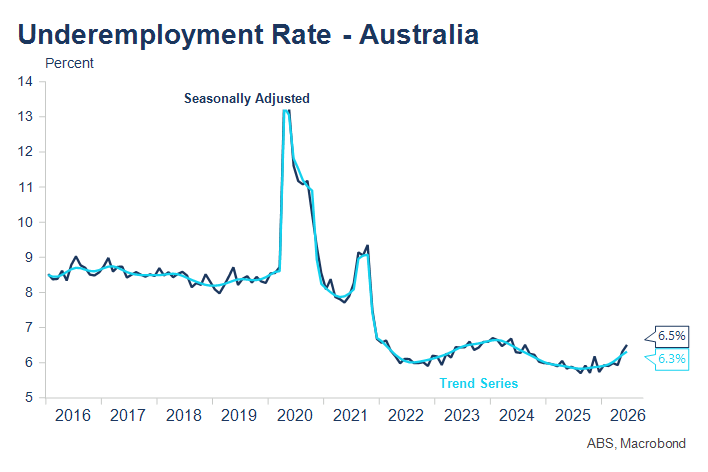
- The trend in the unemployment rate and underemployment rate is more important given the recent monthly volatility in the employment data. Underemployment has jumped sharply in the past two months. The data look suspicious (unreliable) to me, but if the trend were to continue, that would be an important development as both youth unemployment and the underemployment rate often reflect labour market weakness quite early. The relative stability of job ads doesn’t support the recent underemployment signal.
- RBA Deputy Governor Hauser also speaks on Wednesday at 12.45pm AEST. Hauser generally is very clear in communicating the RBA’s current thinking and so his fireside chat is important.
- Overall, I remain modestly bearish on Australian fixed income and consider the risk of further tightening of US and Australian monetary policy before Christmas remains under-priced by markets.
Interest rate market developments over the past week
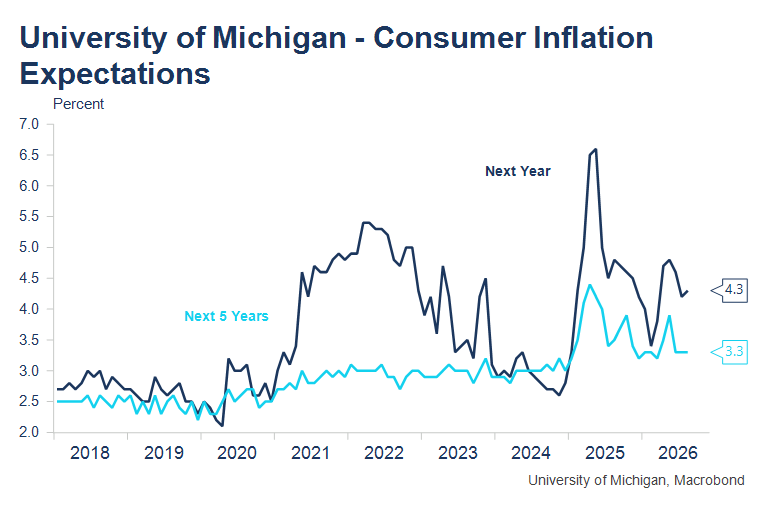
An interesting week with the continuing rise in US longer-dated yields perhaps the most noteworthy development, slight as it was this. This occurred despite another relatively low CPI print and much weaker than expected July Retail Sales data. Higher US inflation expectations in August were perhaps a factor, the one-year ahead measure in the University of Michigan survey ticking up only slightly to 4.3% but remaining stubbornly above 4%. Oil prices were slightly higher over the week, but not dramatically so, as there were few developments in reopening the Strait of Hormuz. Japanese long bond yields continued their trend higher in yield also, a continuing negative for longer-term yields globally.
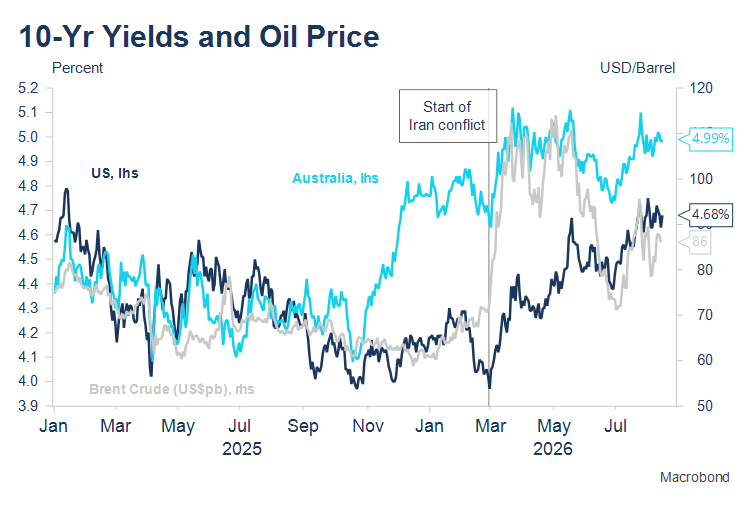
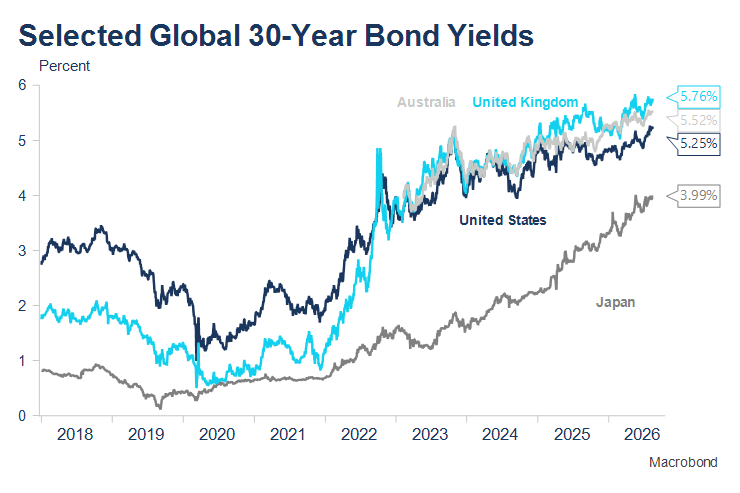
Since new Fed Chair Warsh’s first Press Conference at which he professed a preference for market signals, the US 30-year bond has risen around 35bps. Old timers like yours truly would increasingly interpret that as a signal from the market that the Fed is getting “behind the curve” and that monetary policy should tighten somewhat. To be clear, the message of the bond market is not a dramatic one but is still a signal that policy needs to be tightened somewhat.
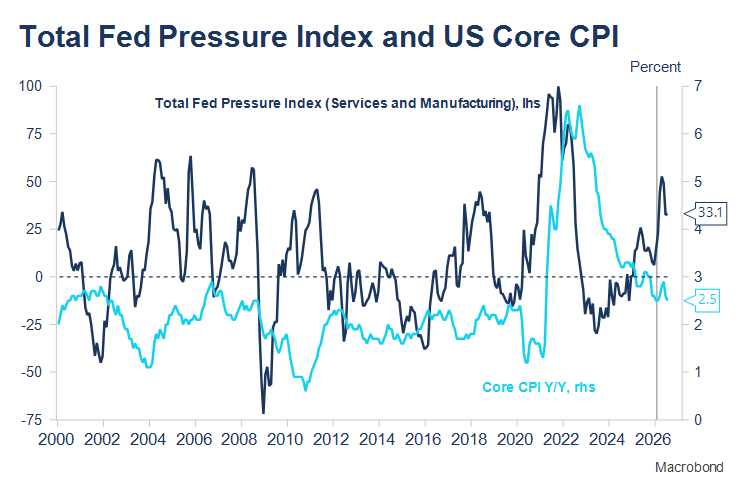
How does that square with the latest inflation data? At face value, the sell off runs counter to the message of last week’s July CPI and the weaker than expected July Retail Sales figures. However, the 30-year bond yield is very forward looking and is likely being influenced by the signals of emerging inflationary pressures in the ISM surveys. These remind that inflation is a lagging indicator and warn some stronger CPI prints lie ahead.
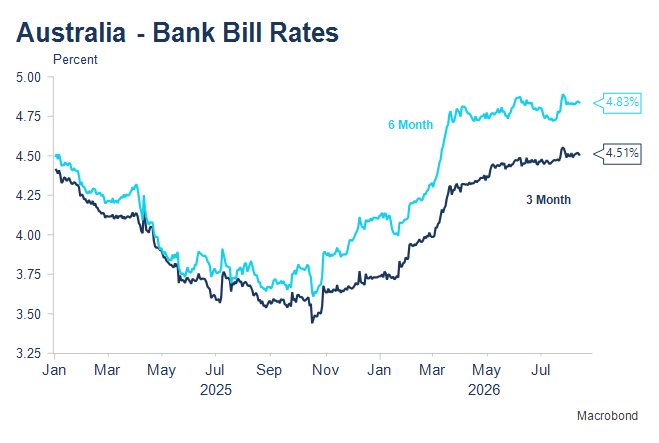
Australian yields were relatively unchanged this week, with the RBA delivering a hawkish sounding hold, which was mostly ignored by the market. I continue to think another tightening is much closer to being delivered than the broad consensus of economists’ forecasts and the markets’ pricing which is discounting only just over a 50% chance of a further tightening by the end of the year and a peak tightening probability of one further tightening of only 65%.
The Statement on Monetary Policy concluded that there were upside risks to inflation. When the RBA signals risks (in either direction), these are often acted upon within a three month period. The Governor also confirmed that the case for a rate rise had been discussed at this meeting (it wasn’t in June), while the Governor also noted in her press conference that personally, she thought the Bank would need to go (tighten) again! The reason for the hold at this meeting – as in June – was the Board wished to receive further information on how the economy and inflation were responding to the three interest rate increases implemented during the first half of the year.
There wasn’t too much Australian data out during the past week, though the NAB Business Survey showed some developments of note:
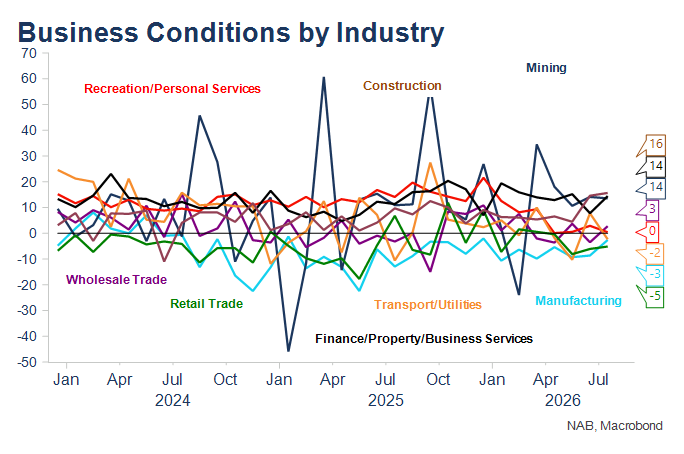
- Businesses overall are reporting broadly stable business conditions just a little below the long-term average for the series. That’s a credible effort in my book, given the combined effects of higher interest rates and higher oil prices in recent times.
- There is however an increasingly divergent picture of the economy emerging by sector, with construction, mining and property, finance and business services much stronger than the consumer exposed and industrial parts of the economy. That fits with the differing pressures on businesses and consumers at present with higher oil prices and interest rates a drag for most businesses (and consumers), but the AI investment boom, a boon for others. The latter is particularly evident in construction, which reported the strongest business conditions of any sector for the second month in a row. That suggests inflationary pressures in this sector (both materials pricing and higher wages) will likely persist, which will make it hard for the RBA to achieve its inflation target at current interest rates.
- The tentative easing in capacity utilisation evident in recent months has not continued and indeed has reversed a little. Several Australian forecasters changed their view on the outlook for Australian interest rates based on that prior easing in capacity utilisation and the correlation of that series with interest rates (which I respect, but do not expect to be sustained on this occasion).
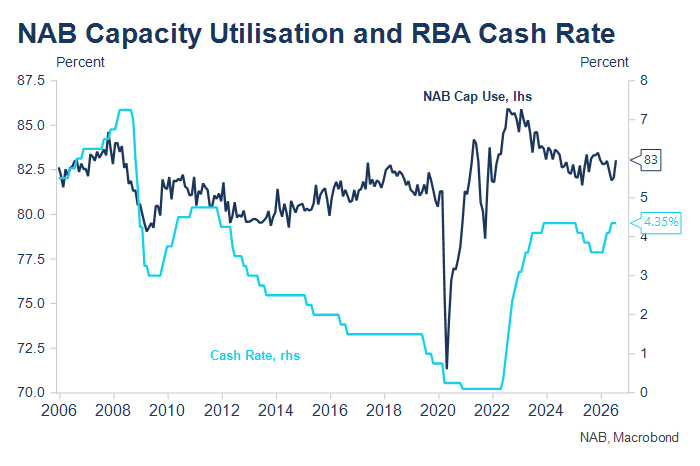
The near-term outlook for Australian interest rates hasn’t changed much this week. The market continues to attach around a 66% chance to one further interest rate tightening by the RBA, by the middle of next year, but only around a 50% chance of an increase by Christmas. I continue to assess that as too low a probability and consider a further rate rise by the end of the year as highly likely. Either the monthly core inflation prints would need to begin to moderate more convincingly or the unemployment rate continue its near-term trend rise, to dissuade me of that view. It seems there is enough momentum continuing in the economy given the global AI investment boom for there not to be significant easing in inflationary pressures, especially sufficient wages moderation, given the continuing low level of the unemployment rate.
Importantly, the AI investment boom is a demand-driven event for inflation. Tighter monetary policy isn’t likely to restrain that investment, but it can make room for aspects of that boom in other parts of the construction sector.
One final thought on the RBA’s assessed upside risks to inflation. After around five years of above-target inflation, the RBA Board is risking further damage to its credibility by not tightening policy. This becomes less reasonable the longer the Board delivers inflation above target.
Australian and US key events calendar
It’s an interesting week coming up in Australia with important updates on wages and the labour market, along with a fireside chat with RBA Deputy Governor, Andrew Hauser. I enjoy listening to Hauser’s speeches and chats and find that he very much calls it as he sees it. The WPI is expected to be unchanged at +0.8% q/q in Q2, consistent with a 2.5% inflation outcome given Australia’s poor productivity performance. Q3 WPI data should be of more interest given the recent higher-than-expected minimum wage and modern award wages decisions.
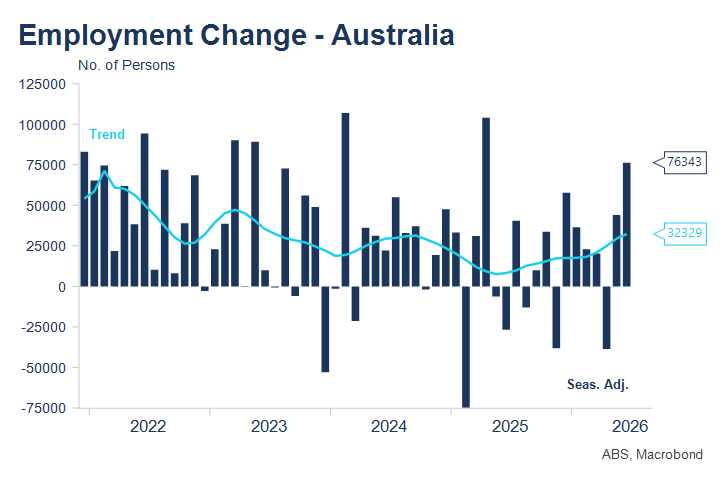
Last month’s labour force of course surprised strongly on the high side (+76K), something that was the risk after the weak April outcome and after the ABS warned of significant numbers of people with jobs but still waiting to start in May.
After such a large rise in July, the risk would seem to be on the downside this month, but any softer result should not be over-interpreted as emerging weakness. Economists expect slower 15,000 jobs growth. Encouragingly, SEEK job ads have been broadly stable in the past two months after slipping in May.
There may be some slight support for employment from the Australian Census, with AI suggesting some 30,000 workers hired by the ABS to assist with the Census, with some 16,000+ field officers used in July and August. Some of these workers would have other jobs.
Of more interest for me, the key will be how the unemployment rate tracks. It has been drifting higher in recent months, with the underemployment rate jumping sharply in the past two months. The latter data looks somewhat suspicious, and I am wary of a reversal (there was a similar temporary jump in the middle of last year).
In the US, Wednesday night’s FOMC Minutes are the key event, though I believe there should also be focus given to manufacturing indicators, which have been recovering in part due to AI-related spending.
The debate at the FOMC meeting on inflation – especially AI, tariff and Iran-related inflation – is of keen interest to me, especially given there were three dissents at this meeting. The previous Minutes had highlighted two scenarios for policy, one of which concluded that some firming of policy would likely be necessary to achieve prices stability if the labour market remains stable. It will be interesting to see the extent to which there have been any developments in the views of the Committee in this regard.
All times shown are AEST.
Tuesday 18 August
- 10:30am Westpac Consumer Sentiment - August
- 11:15pm US Manufacturing Capacity Utilisation – July (76.3% expected; 76.1% previous)
Wednesday 19 August
- 11:30am Wage Price Index, Q2 (0.8% q/q, 3.2% y/y expected; 0.8% q/q, 3.3% y/y previous)
- 12:45pm RBA Deputy Governor Hauser, Fireside Chat
- 03:00am US 20-year bond auction
- 04:00am FOMC Minutes – July Meeting
Thursday 20 August
- 11:30am Labour Force – July (Employment +15K, Unemployment 4.4% expected; Employment +76K, Unemployment 4.4%, previous)
- 10:30pm Philadelphia Fed Manufacturing Survey – July
- 03:00am US 30-year TIPS auction